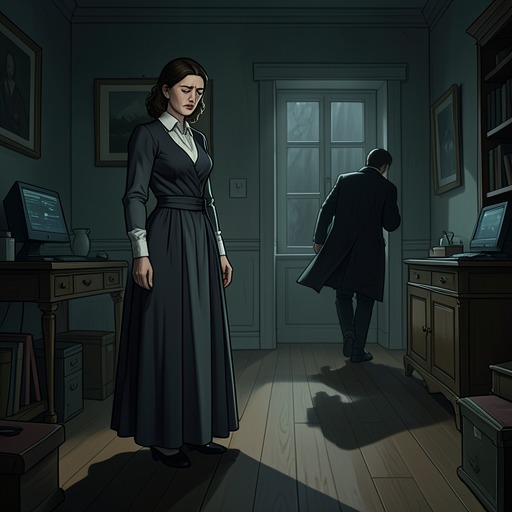
« Oh, que je suis bien auprès de toi, Stefa »
Felix AustriaFather Josef’s expression of how good he feels beside Stefania becomes more than a tender compliment: repeated in her memory, it turns into an intimate promise of lifelong closeness and a refuge from the world. The phrase begins amid baskets of cakes and words about care, but its recurrence transforms that ordinary exchange into a charged, bodily fixation for Stefania.
The phrase in its first setting
Father Josef speaks beside Stefania and the baskets, sighing with a voice described as pained and almost groaning. He says he could spend his life there with her and the baskets, then names her talent as looking after other people. He calls that care a genuine gift, urges her not to lose it, and adds that she must sometimes look after herself and let others do the same. The phrase is thus first joined to a concrete act of care: Stefania has brought him cakes, and he thanks her for them.
The exchange makes his words both intimate and seemingly benevolent. He says that he feels he has known Stefania always, even before, and that the Lord does not unite people without a reason. He also says she teaches him things. After Stefania hides her burning face in her hands, he is so close that his lips graze her fingers; she senses his breath and the warmth of his body. He then blesses her almost silently with the sign of the cross. Gratitude, spiritual language, physical proximity, and a blessing converge around the phrase, leaving it difficult to separate comfort from intensity.
Repetition and remembered intimacy
In Stefania’s later recollection, Father Josef’s sentence returns not as a single remark but as a refrain. Its elements recur in variations: being well beside her, spending a whole life there, being together, and remaining in a hiding place. His voice is remembered as afflicted and dreamy. Repetition enlarges the original moment, turning the possibility of sitting together among baskets into an imagined shared life.
The remembered words are inseparable from images of shelter. Father Josef’s white wings hide Stefania from the rest of the world as he holds her to his chest; the fantasy of staying beside him becomes an image of being concealed and enclosed. Stefania’s memory links that shelter to the idea of their trunks entwining and to his invitation to come with him. These images do not establish a life they actually share; they show how the phrase takes shape inside Stefania’s recollection as a wished-for refuge.
Bodily force and collapse
The phrase is accompanied by physical reactions rather than calm reflection. In the recollected scene, Stefania experiences a tightening stomach, burning chest, pounding heart, and difficulty breathing. She says that she relives being beside Father Josef thousands of times and hears the same words again and again; each replay leaves her barely able to resist. The remembered sentence therefore acts as a trigger for an involuntary cycle of closeness, tension, and renewed distress.
Specific sensory details bind the refrain to the earlier encounter: incense, the vanilla custard in the cakes, the taste of sweetness, and the roughness of fingers. Stefania recalls Father Josef touching her lips with his rough fingers and looking at her lips. His recalled remark that she is as untidy as a little pig, and that they are alike, folds teasing and likeness into the same intimate scene. The words about being well together acquire force through this accumulating sensory memory, not through a declaration detached from the body.
Meaning and limits of the refrain
The phrase carries a marked tension between Father Josef’s spoken concern for Stefania’s self-care and the refuge Stefania imagines in total closeness to him. His first words explicitly advise her to let other people care for her; in her recollection, that offer becomes an overwhelming desire to remain hidden with him for a lifetime. The shift shows the phrase’s changing meaning in the narrative: what begins as gratitude and counsel becomes a repeated emotional fixation.
The passage does not confirm that Father Josef makes a formal promise or that the imagined life together comes to pass. Instead, Stefania’s memory intensifies his words through repetition, bodily sensation, and images of enclosure until she says she has no strength left and loses consciousness. The refrain’s consequence is therefore not resolution but collapse. Its tenderness remains entangled with distress, and the scene closes in a plea for mercy and an appeal to the Lord rather than in any settled answer to what the words mean.